caridb

Archive for the ‘General’ Category

TRAPped

In General on December 29, 2011 at 10:15 pm

Earlier this year, the Governor of Virginia developed a set of regulations under the guise of monitoring the quality of abortion care.  Sounds like a reasonable – even worthy – cause, right?  Don’t be fooled (or “trapped,” rather) by the rhetoric.  Targeted Regulation of Abortion Providers (or TRAP) is motivated by political agendas and religious dogma, not by genuine concerns for patient care and safety.  Abortion clinics, like all health centers, are already regulated by a variety of oversight agencies.  There is simply no legal or medical reason for treating abortion doctors differently than providers of other outpatient procedures of a similar nature and complexity.

The Virginia TRAP laws, set to take effect in January, are alarming for several reasons.

First, they were issued through an “emergency” administrative process as opposed to routine legislative procedures, thereby skirting most opportunities for public review and comment.  So… what’s the emergency?  Are women dying, experiencing high infection rates, or getting sick after abortions in Virginia?  Nope.

Note:  According to the Guttmacher Institute (among other sources):  “Abortion is one of the safest surgical procedures for women in the United States.  Fewer than 0.5% of women obtaining abortions experience a complication, and the risk of death associated with abortion is about one-tenth that associated with childbirth.”

Secondly, the medical expertise that was actually solicited was, ultimately, discounted.  Several members of the medical committee that advised the state about the regulations have indicated that the final version looks quite different from the one originally drafted.  In short, they said that the regulations went way too far.

Finally, and most significantly, the regulations treat abortion clinics as a type of hospital, thereby subjecting them to burdensome – and unnecessary – structural building requirements.  Typically, when such regulations are implemented, existing facilities are “grandfathered” in.  Not the case here – but not terribly surprising, since the Governor and his Attorney General have made no secret of their staunch opposition to abortion rights.

The draft regulations are nineteen pages long and reference numerous other statutes and regulations, which makes reading them – let alone fully comprehending their impact – a wild goose chase of sorts.  Let’s be clear:  regulation itself is fine – really!  I don’t think any abortion provider would dispute the need for some level of external oversight and guidelines.  But they must be reasonable and appropriate.  And by all – even objective – standards and criteria, these regulations are not.  As one doctor (sort of) joked:  “I can do open heart surgery in a place where I could not perform an abortion!”  The point is, we’d all be hard pressed to identify another area of medicine in which politicians are allowed to meddle in the actual content of practice in this way.

These are just the kinds of laws that the general public – no matter how pro-choice – overlooks.  From the outside, they seem relatively harmless.  In essence, they are back-door measures that enable anti-choice zealots to chip away at abortion access without ruffling too many feathers.  But these are the very laws that make abortion harder to get and more expensive.  They affect women indirectly – by penalizing those who provide the service.  And let’s be honest:  abortion providers already have it pretty tough – hounded by protestors, ostracized by the mainstream medical community, even threatened with physical harm.  So rather than basking in a warm holiday glow this week, a few dozen committed Virginia physicians and their dedicated staff will instead be worried about their jobs… and, ultimately, the women they serve – women who, right now, may have no idea that this is even happening. 

Note:  It’s worth pointing out that even before these burdensome regulations came into play, approximately 85% of Virginia counties had no abortion provider; 54% of Virginia women live in these counties.  Some clinic administrators estimate that all but a handful of Virginia’s twenty-some abortion providers will be unable to comply with the new regulations and will have to close up shop within the next two years.

Ironically, in the Governor’s recently-released budget, he all but eliminated funding for teen pregnancy prevention programs and for HIV prevention and treatment programs, but he added money for additional inspectors of abortion clinics.  Talk about trapped.  Sounds like a well-hatched plan to hold women and their families – especially the most vulnerable ones – hostage by “tying up” the very people who are there to help them.  The Governor and his cronies have a constituency to serve, but it sure as hell isn’t women seeking abortions.  And these regulations aren’t about ensuring the safety of abortion facilities, they are about closing them down — for good.
Ain’t I A Person?

In General on November 7, 2011 at 8:35 pm

This week Mississippi voters will weigh in on a state constitutional amendment that defines legal personhood at fertilization. One New York Times writer described the initiative as a new tactic in the abortion fight, but as far as I can tell, there’s nothing terribly novel here. Anti-abortion groups long ago staked a polarizing claim in this debate by pitting the needs and rights of pregnant women against those of their embryos and fetuses. In doing so, they created the framework for an adversarial campaign between what they purport to be two entirely separate beings: selfish, irresponsible mother and innocent, unborn child. In reality, however, these two lives are inextricably linked, physically and otherwise.

Desired or not, pregnancy begins a relationship, and a woman must decide how to best manage that relationship – based not only on her own interests, but also on those of the potential child, her existing family and her larger community. Women alone carry this privilege and this burden, not because we are alone, but because our biological role cannot be shared or traded with men. For this very reason, a woman must have ultimate decision-making authority over the outcome of her pregnancy. Abortion opponents perhaps take solace in their view that women make impulsive and frivolous decisions about pregnancy, but this is a broad mischaracterization. Women do not abort because we devalue new life; to the contrary, we plan the size and spacing of our families out of respect for humanity, out of an understanding for the complexities and complications of our lives. Ending a pregnancy that is undesired and for which one is unprepared is in fact a very loving – even “motherly” – thing to do.

Our reproductive decisions are central to our individual identities, but they are also crucial to our group survival. In fact, maintaining control of our reproduction is one of the ways that we preserve the health and longevity of our human existence, for it allows us greater opportunity to create and maintain the ideal circumstances in which to conceive, bear and raise children (or not to, as the case may be). When our families thrive, so does our society. Ironically, limitations on our reproductive rights are not subject to the same scrutiny as other matters involving infringement of bodily integrity, even where actual children are concerned. For example, a parent cannot be forced to provide an organ or bone marrow to his or her child of any age, even if that act is necessary to save the child’s life. How, then, can we morally or legally justify compelling a woman to unwillingly donate her uterus – her body! – to the unborn? How can we even debate the personhood of a fetus, an embryo, a fertilized egg (!), if that categorization necessarily reduces a woman’s status to the equivalent of a vessel? Ain’t I a person, too?

The culture of shame and secrecy that has developed around abortion has enabled society to superficially isolate it as a separate and distinct act, void of any context and disconnected from the rest of our sexual and reproductive lives. But abortion is actually a very natural part of our biological cycle. A significant number of pregnancies (estimates range from 10-50%) end in spontaneous abortion, oftentimes before a woman even knows she’s pregnant. Even nature (or our Creator!?) understands that all pregnancies cannot and should not result in children. Abortion is as much a part of our social history as any other sexual or reproductive event. Women have sought and developed “organic” methods of abortion since the beginning of time – or at least long before the strict regulation and “medicalization” of the procedure and the ensuing cultural and political wars. An objective and compassionate understanding of the human condition includes a recognition of the rightful place of abortion along the continuum of experiences that make up our “childbearing” years. Sure, abortion is a tough issue – but so are many matters that we confront related to our intimate relationships and our reproductive health. That doesn’t make abortion wrong, evil or sinful – and it certainly doesn’t make it murder.

The only “new” thing about this ballot proposal is the backtracking of the debate’s starting line from conception to fertilization. This would outlaw not only abortion, but also certain birth control methods, and could create murderers out of miscarrying women and the doctors who help them. It’s such an extreme measure that even some “pro-life” leaders oppose it, and, if it passes, our (conservative) Supreme Court will undoubtedly strike it down. But the amendment itself is surely not the point. There will be months, years of litigation; there will be similar initiatives in other states, generating more opportunities for the spread of misinformation and abortion-related stigma; and there could be an immediate – albeit it temporary – negative impact on healthcare services for women. One supporter of Proposition 26 told Diane Rehm of NPR last week that “actually, it [the amendment] doesn’t change anything.” Even if, when all is said and done, that’s true, the collateral damage will have already been done. Just ask any woman struggling with an unplanned pregnancy: it changes everything.

Do they really think we’re that stupid?

In General on July 26, 2011 at 10:30 pm

Many have said it, but I’ll say it again:  NC HB 854 (aka Woman’s Right to Know Act) is a solution in search of a problem.  This bill assumes that women are impulsive and thoughtless when it comes to decisions about their families and their health.   Furthermore, it implies that abortion providers are nonchalant about their work and unconcerned with the realities of their patients.  These “allegations” are both unfounded and unfair.

The “purpose” of this Act is itself misleading:  “to require… the informed consent of a pregnant woman before an abortion….”  It insinuates that, without this law, women are having abortions performed on them without their consent!?  As a matter of course, all medical procedures require informed consent, and abortion is no different.  Healthcare professionals share a uniform understanding of informed consent that includes risks, benefits and alternatives; abortion providers are no different.  In fact, given the controversial shroud under which abortion providers work, no one is more concerned about adequate consent procedures than they – for the physical and emotional well-being of their clients, as well as for their own legal protection.

The authors and supporters of this bill are, in effect, using shame to discourage abortion.  But “guilting” women into having children is no more acceptable than “guilting” them not to.  Imagine arriving at your first prenatal visit, wrapped in the glow of your excitement at the knowledge of your soon-to-be child, to be presented with mandated, scripted information that includes things like 1) all possible complications of pregnancy and childbirth; 2) all known potential birth defects and infant illnesses; 3) the average amount of sleep loss following childbirth; 4) the total cost of raising a child; 5) the possible impact of child rearing on your career, your relationship and your sex life, etc.  “Now, before I show you this ultrasound, are you SURE you want to have a baby?  I am required to remind you that you can obtain a safe and legal abortion up to 20 weeks of pregnancy.  I can provide you with the names and contact information for several reputable abortion clinics in the area, if you like.”  While some or all of this information may be of value to you, a responsible and ethical healthcare provider would never assume that you want or need it, or force it upon you.  By the same token, the state cannot and should not assume that it knows best what information to provide to each individual woman seeking abortion services, or how and when to provide it.

The authors and supporters of this bill are, in effect, creating additional burdens and hardships in order to make abortion inaccessible.  The imposition of arbitrary timeframes – disguised as meaningful pauses for reflection – serve only as financial and logistical roadblocks for women involved in a precarious balancing act of childcare coverage, transportation arrangements and time off from work.  Adding time and steps to the process also increases the overall cost of providing services, resulting in higher fees for patients, and – potentially – in fewer available providers (as increasing costs and unreasonable regulations force some of them to throw in the towel altogether). 

The anti-abortion movement has been unsuccessful in garnering the support of the majority of Americans because, quite simply, Americans support a woman’s right to abortion as a viable alternative to unwanted pregnancy.  Given this reality, the anti-abortion contingency long ago changed its strategy to include back-door tactics like this one, camouflaged as harmless – even helpful — measures that ultimately impede women’s ability to obtain the kind of care they want, need and deserve.  Let’s call a spade a spade:  this bill is not about informing women.  Rather, it is a condescending and manipulative piece of legislation that seeks to restrict abortion by shaming women and complicating their lives.  I guess (the majority of) our legislators just think we are stupid, stupid, stupid.

Abortion Dollars and Sense

In General on May 31, 2011 at 10:19 pm

Abortion is a complex matter and controversial topic for many people.  I get it.  What I don’t understand is why abortion has become a front-running issue in the ongoing budget debates in this country.  As our state and federal legislators haggle over which programs to cut and which taxes to raise, what does abortion REALLY have to do with it?

Absolutely nothing.

The Hyde Amendment has prohibited the use of federal funds for abortion (except in very limited circumstances) since 1976.  As such, low-income women in North Carolina can access prenatal care, but not abortion services, through Medicaid.  Efforts to strip Planned Parenthood of Title X funding because it is an abortion provider are terribly misguided, since the funds in question are exclusively utilized to provide wellness exams and contraceptives (which, last I checked, help to prevent unintended pregnancy – and by extension, abortion).

Ironically, if the government did subsidize abortion, it would actually save taxpayers money.  A first trimester abortion costs less than $500, while labor and delivery expenses run upwards of $7,000 for a normal, uncomplicated pregnancy.  (And that’s not even incorporating prenatal care or subsequent support for a child’s healthcare and other basic needs.)  I certainly don’t mean to imply that all women on Medicaid would or should opt for abortion, but shouldn’t they be able to make that decision based on something other than what’s “covered”?  In fact, to deny them this opportunity is a violation of their civil rights, because it intentionally discriminates against the poor and disproportionately impacts minorities.  No other constitutionally guaranteed freedoms are subjected to such financial requirements and procedural hoops.  Frankly, I don’t want my tax dollars misused in this way.

But Republicans aren’t satisfied with restricting the use of public funds; they also feel the need to dictate the parameters of private insurance coverage and tax credits where abortion is involved – more than slightly ironic, since one of the tenets of the GOP platform is less government intrusion into personal matters.  Yet, in this instance, they seem to have no qualms about interfering in the (privileged!) doctor-patient relationship and, ultimately, about telling us how to spend our money.  Not unlike a woman who opposes abortion in general but has one herself, many Republicans seem untroubled by the great hypocrisy at play here.

Given what is at stake, it feels like nothing less than dirty, back-door politics to mask the true motivations behind — and potential consequences of — the so-called bans on taxpayer-funded abortion.  If we are to enjoy a true democracy, the actions of our representatives must reflect the will of an informed citizenry.   This is not about money.  Sound bites that make a connection between abortion and our budget woes are the makings of a ridiculous smoke screen.  The proponents of these bills are simply exploiting the financial vulnerabilities of Americans to advance their personal anti-abortion agendas.  It’s time to call them on these deceitful practices and to refocus our leaders on the country’s real priorities of the day:  jobs and financial security for all.

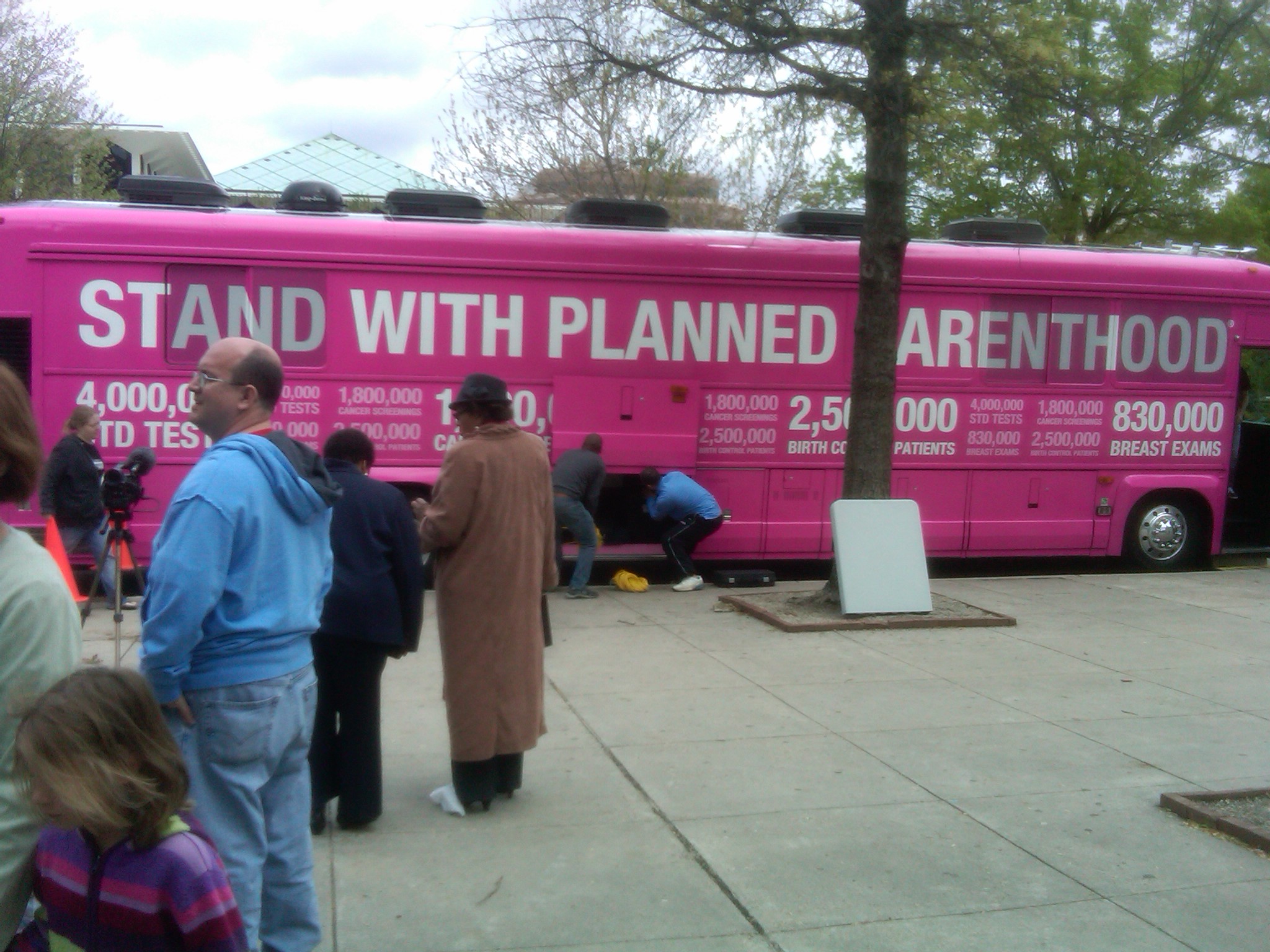
Why I Stand with Planned Parenthood

In General on April 7, 2011 at 10:00 pm

Sadly, there was no Planned Parenthood where I grew up in rural West Virginia; my first encounter with the organization was as a college student in North Carolina.  Following a referral by campus health for an abnormal pap smear, I found myself all alone at a local ob-gyn’s office for a colposcopy.  Since I didn’t really know what a colposcopy was or fully understand why I needed one, I was considerably anxious.  My most salient memory from that visit is the doctor’s reaction when a single tear slipped from the corner of my eye during the procedure.  In what I can only guess was an awkward attempt to comfort me, this rather gruff, older man asked:  “Now, how are you going to have a baby one day if you can’t tolerate this?”  I knew there had to be better, kinder care out there, and soon after I found Planned Parenthood, where I received a thorough explanation of my diagnosis and of the various treatment options available.  That was about twenty years ago, and I’ve stayed with Planned Parenthood ever since for my gynecological and contraceptive healthcare.  I have stayed not because I’m broke or uninsured – I’m one of the lucky ones who has had decent medical insurance coverage for most of my adult life – but because I know it’s a place where I can count on competent, nonjudgmental care.  I stand with Planned Parenthood because I am an appreciative and satisfied client.

I also had the privilege of working for Planned Parenthood – in various roles – for several years.  During that time I encountered some of the most committed, compassionate and talented people I have ever met.  I witnessed firsthand the creative and efficient use of limited resources; I marveled at the nature and breadth of accomplishments made under very challenging conditions; and I participated in the provision of services that, in both small and great ways, changed people’s lives for the better.  But perhaps what best illustrated for me the nature of this organization was the warm and supportive response I received upon my resignation, when – during a time of significant growth and transition for the agency – I announced to my work family my desire to stay at home with my infant daughter.  Rather than dwell on any concerns about project delays or workload issues, which often arise in such situations, my colleagues instead celebrated my choice:  my child.  I stand with Planned Parenthood because I am a proud and appreciative former employee.

Finally, I stand with Planned Parenthood as a woman of childbearing age, because if tomorrow I learned I was pregnant, I would likely choose to have an abortion.  And in that case, I would want to be able to go to the same caring professionals who have provided me with quality gynecological care and birth control for years.  I consider abortion services part of my potential healthcare needs – my comprehensive, preventive, reproductive healthcare.  I recognize that in today’s social and political climate – where funding is on the line, votes are at stake, women’s rights are in jeopardy and providers’ safety is compromised – it is perhaps more politically savvy and fiscally responsible for Planned Parenthood leaders and supporters to highlight the importance of less controversial health services, like breast exams and pap smears.  But I also worry that – in the long run – we do ourselves a great disservice by (ever so subtly) apologizing for abortion, as if the concept of choice is a noble one, but the act of abortion a necessary evil.  And so, I stand with Planned Parenthood not in spite of the fact that it provides abortion, but because it provides abortion.  I stand with Planned Parenthood because what it stands for remains tried and true:  every child a wanted child.  Who can’t stand up for that???

If Men Could Get Pregnant

In General on March 29, 2011 at 12:30 pm

 I was 19 and spending a semester in Mexico when I first found out I was pregnant.  I was shocked – no mind that I had missed my period for several months and was gaining an unprecedented amount of weight.  Denial is a powerful thing.  It took the kindness and generosity of several people, not the least of whom was my mother, to work out the logistics of getting me back to the United States, to an abortion clinic with the necessary funds in hand, and eventually back to finish my studies abroad.  They saved my life — maybe not in the technical, medical sense — but save it they did.

There was never any doubt for me that I would have an abortion; it was my immediate reaction.  There was no ambivalence, no discussion, no research, no “what if’s.”  I did not want to be pregnant.  I did not want to be a mom.  Not then.  But I know for some women it is not this “easy.”  For some, the decision is difficult and emotional, replete with conflict and guilt.  I know this because I worked in abortion clinics for years.  I listened to women ask if they would go to hell, if they would ever be able to get pregnant again, if anyone would be able to “tell” that they’d had an abortion.  I heard them admit that they were always against abortion, but — just this one time — they really needed one.  And now, as our Congressmen (OK, some women, but mostly men) endeavor to pass legislation further restricting access to abortion and stripping organizations like Planned Parenthood of federal funding, I pause to take stock, and I wonder:  what if men could get pregnant?

If men could get pregnant, there would be no abortion controversy.  If men could get pregnant, abortion would be as available as a walk-in haircut.  In fact, it would be free.  If men could get pregnant, every doctor would know – would be required to know – how to perform an abortion.  If men could get pregnant, we would have scientists working around the clock to figure out how to make abortion “pain free.”  In fact, it would come complete with a spa visit.  If men could get pregnant, it would be sin, maybe even a felony, to make someone feel bad about having an abortion, or to in any way impede his ability to get one.  If men could get pregnant, there would be no scarlet letter “A” for abortion.

Yes, I exaggerate for effect, and no, I do not hate men or even blame them for the current state of affairs.  In fact, I think men should have abortion rights, too.  Parenting is too important and too hard to be forced on anyone.  Pro-life advocates claim a higher moral ground because they “defend” the lives of unborn babies.  But by denying women access to abortion care, they effectively turn some babies into a punishment for sex.  What kind of life is that?

Now that I am a mother, some friends ask me if I feel differently about having had an abortion.  To the contrary, I am only more convinced that it was the right thing to do.  I am madly in love with my daughter, and I now know the critically important task and constant challenge that is parenthood.  I had no business bringing a baby into the world back then.  Today I am a better mom – in fact, I am a better citizen – because I had the opportunity to decide my own fate.

Abortion is one of the most common medical procedures in this country, and women have abortions for all sorts of reasons.  The one I hear the most is that they want to be able to take better care of their families, the children they already have, or those that they someday will have.  Sounds pretty darn responsible to me.  But quite frankly, I don’t care what the reason is.  If men could get pregnant, the reason wouldn’t matter at all.